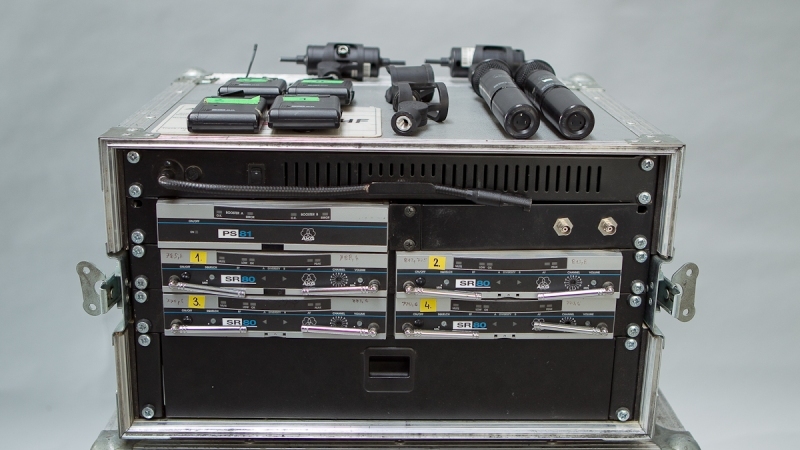
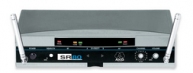
The SR 80 is a stationary receiver for use with all WMS 80 Series transmitters. Housed in a half-rack case, the SR 80 combines professional technology with ease of use and maximum reliability. 15 selectable UHF frequencies provide for simultaneous operation of up to 19 channels* (depending on local frequency plans) and maximum flexibility in environments hostile to RF propagation. A digital Four Level Diversity system ensures highly reliable reception and reduces dropouts to a minimum. With an adjustable squelch, output level control, and professional XLR and 1/4" outputs, the SR 80 is a perfect tool for any application from small clubs and theaters to open-air stages and sports facilities.
For professional users or discriminating amateurs, the SR 80 is one of the most reliable and powerful receivers on the market today.
AKG Acoustics
AKG stands for "Akustische u. Kino-Geraete Gesellschaft m.b.H." (i.e. Acoustic and Cinema Equipment). In 1997 the name changed into AKG Acoustics GmbH..
AKG Acoustics is widely recognized as the most innovative manufacturer of microphones, wireless systems and headphones in the world. Since its founding in Vienna, Austria in 1947, the company has been granted over 1,500 patentsâ??more than all of its competitors combined.
Used Microphones
Microphones are, along with speakers, the most essential component of any communication system. Basically, microphones are a type of acoustic-to-electric transducer, which is able to deliver sound to a remote receiver either through a cable, or more commonly nowadays, wirelessly, by converting the sound input into an electrical signal.
Today, microphones are used for numerous different applications. Microphones can be found inside our telephones, radios, computers, hearing aids etc, and then thereâ??s the stage mic, an essential item for any stage or television performer.
A modern mic can actually use a range of techniques to record sound and convert it into an electrical signal that the receiver can convert into sound. One of the most common types of microphone, the dynamic microphone, uses electromagnetic induction. Dynamic mics are actually very simple in design and have few moving parts, which is one of the reasons they are so popular, as this feature makes them a lot more rugged than other types, such as the condenser microphone, which are able to record a wider sound frequency yet are far more fragile.
Dynamic microphones are ideal for recording the sound produced by loud guitars, drums and amps, thanks to their ability to withstand high SPLs. However, this design incorporates a wire coil and thick diaphragm which makes them unable to pick up the highest sound frequencies. When the ability to pick up higher sound frequencies is required, a condenser microphone is the preferred option for musicians and technicians alike.
Condenser microphones work differently to dynamic microphones, as they use capacitance rather than electromagnetic induction to pick up audio. The downside is that this system requires more vulnerable parts to be used, and so these mics can be damaged fairly easily.
Other types of microphone are also available for specialist applications, including the wireless microphone, electret microphones, laser microphones and fiber optic microphones.