Moving Mirror Scanners are often used for club lighting, as well as for stage lighting, and are quite similar in concept to moving lights in that they offer increased versatility and can be used to create more complex special effects than conventional stage lights. Scanners have actually been around for years â?? indeed, they were the first ever kind of moving lights, preceding the more popular intelligent lights that are now used today.
The main different between moving mirror light scanners is that, unlike more modern moving lights that have mechanical light fixtures, scanners rely on â??mirrors that moveâ? to direct the light beam, rather than moving light components. The fixture of the scanning head light doesnâ??t actually move by itself. Rather, it contains a built in mirror fixed to a pivot point that moves around and directs the beam of light which is focused onto it.
Much like a moving lights, scanners or club lighting can be pre-programmed before a production so that the operator doesnâ??t have to control the light through the duration of the show, though of course some skilled operators prefer to operate the lights manually, during the performance, if they have the experience to do so.
Scanners are available in a wide range of different sizes, and offer many different types of features to lighting technicians. Features include high-resolution stepping, high-resolution glass gobos with indexing and rotation, color mixing, mechanical dimming, remote focus, electronic strobing and many more.

Built-in beat activated and automated programs (stand alone) Double bracket yoke doubles as floor stand Automatically enters stand alone when no DMX signal is present Linkable via master/slave Linkable with InsigniaTM, InsigniaTM2.0, IntimidatorTM, I...

Built-in beat activated and automated programs (stand alone) Double bracket yoke doubles as floor stand Automatically enters stand alone when no DMX signal is present Linkable via master/slave Linkable with InsigniaTM, InsigniaTM 2.0, IntimidatorTM 1...

Built-in beat activated and automated programs (stand alone) Double bracket yoke doubles as floor stand Automatically enters stand alone when no DMX signal is present Linkable via master/slave with Smart LinkTM Linkable with IntimidatorTM 1.2 and Int...

Built-in beat activated and automated programs (stand alone) Double bracket yoke doubles as floor stand Automatically enters stand alone when no DMX signal is present Linkable via master/slave Linkable with InsigniaTM, IntimidatorTM, IntimidatorTM 2....
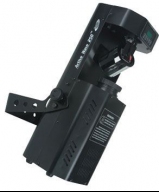
Control Features â?¢ USITT DMX-512 6 DMX Channels (8-bit) â?¢ 4 Digit LED display â?¢ 3 Pin XLR Serial input/output â?¢ Pan postitions barreled mirror â?¢ Tilt rotates mirror at different speeds Features & Specs â?¢ 19º Beam Angle â?¢ Manual Focus â?...
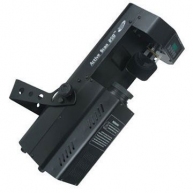
Control Features â?¢ USITT DMX-512 (8-bit resolution) â?¢ 6 DMX Channels â?¢ 4 Digit LED display â?¢ Self test & stand alone settings â?¢ 3 Pin XLR Serial input/output Features & Specs â?¢ High luminous parabolic reflector system â?¢ 19º Beam Angle â...
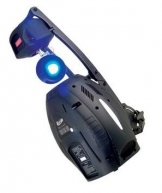
CONTROL FEATURES â?¢ RDMX - Remote DMX Addressing â?¢ USITT DMX-512 (16-bit resoultion) â?¢ 14 DMX channels â?¢ 4 Digit L.E.D. Display â?¢ On board menu settings â?¢ 3-pin XLR serial input/output â?¢ Sound active mode OPTICAL SYSTEM â?¢ High output l...
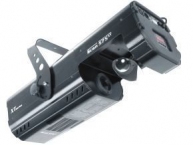
The Scan 575 XT is ideal for bigger clubs and spaces where high light output is vital, thanks to a 575 Watt lamp and specially engineered optics. Features include 2 combinable gobo wheels, one offering static gobos and one with rotating gobos; remote...
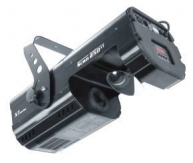
The Scan 250 XT is ideal for all clubs, discotheque or pub applications where an element of colour and sparkle is required. This product is a great choice for those needing more features than the DJ' Scan 250 XT offers. Features include gobo wheel wi...
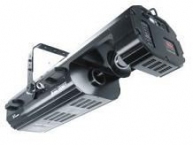
Source * Lamp: Osram HMI 1200W/GS * Base: SFc15,5 * Control: Automatic and remote on/off * Ballast: Magnetic Optical System * Multistep zoom lenses system (15deg, 21deg, 28deg) Electrical Specification * Wiring options: 208/230/240V AC, 50/60Hz * Pow...