Video switchers, also known as a video display controller (abbreviated to VDC) is essentially the key component of a video signal generator. This kind of vision mixer is used for generating a visual signal in computers, and in some cases an audio signal too, although this is just a secondary function. The video switcher first made its appearance in our homes in the first types of home computers, such as the old Commodores and Spectrums, and is now an integral part of video signal generator logic.
A video mixer cannot work alone however, as it needs support from various other parts of the computer to work. For example, pixel data is stored in the computerâ??s RAM, while character fonts are held in the ROM. Therefore, the video switcher chip will usually be totally integrated into the main computer, and so users will be able to see the video RAM it gives in the CPUs memory map. It can also act as a co-processor that acts independently, although this is not usually the case.
The video switcher is generally available in three different formats. Video shifters are the most basic type of production shifter, and take care of the video timing signals. These obtain data one byte at a time from the CPU, and use synchronization signals to produce a video signal. The CTRC video switcher reads data directly from the computerâ??s RAM, and this is then outputted either through a ROM or directly. Far more complex are video interface controllers. This kind of video switcher supports sprites and video RAM which is dedicated towards color attributes, thus making extremely high-resolution images possible.
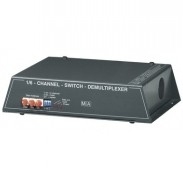
MA demultiplexers receive DMX512 signals and convert them. For reasons of data integrity, any tapping of DMX signals is protected against over-voltage on MA devices. MA demultiplexers are also available as PC-boards for being assembled in lighting ef...
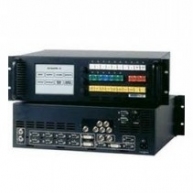
The ScreenPRO-II HD with 3G enhanced output card is able to convert a signal program in another signal thanks to a second scaler. The upgrade to a 3G data transfer rate allows problem-free FullHD transfer(1920 x 1080 @ 50 Hz). With the new own Barco ...
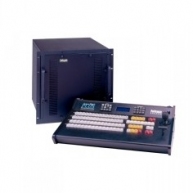
Modular design supports up to six screens Intuitive user interface 16 universal inputs accept composite (NTSC and PAL), s-video, component, and computer sources with resolutions up to 1600x1200. HDTV 480p, 720p, and 1080i formats are supported in RGB...

ScreenPRO II uses four image layers (Unscaled Background, up to two scaled PIPs or Keys, and an unscaled Downstream Key) to produce sophisticated effects, including transitioning backgrounds, transitioning PIPs, wipes, dissolves and keys. Two inputs ...

This device adds flexibility and greater control to multi-screen and single screen events. The controller enhances PIP and KEY placement, source switching, and layer control options during a presentation. The ScreenPRO-II Controller includes access t...
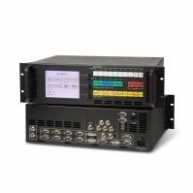
Barco's ScreenPRO-II HD uses four image layers to produce sophisticated effects, including transitioning backgrounds, transitioning picture-in-picture windows, wipes, dissolves and keys. An internal 8x2 analog video router provides universal analog s...

PresentationPRO is a compact, reliable system that simplifies the task of supporting professional quality visual presentations, live events, corporate boardrooms, and church services. PresentationPRO-II is offered in two configurations: The Presentat...
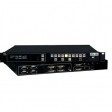
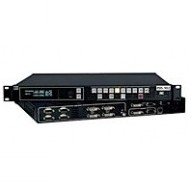
Three models The PDS is offered in four models: PDS-701 3G, PDS-901 3G, PDS-902 and PDS-902 3G. The PDS-901 3G, PDS-902 and PDS-902 3G models feature four DVI-I inputs with full HDCP 1.0 support, whereas the PDS-701 3G features two DVI-I inputs. All ...